One accountable product lead
Scope, interface decisions, technical tradeoffs, and launch criteria have a clear owner.
Custom software for specialized operations
Vyshyvka designs and builds platforms for organizations with unusual records, staff workflows, and publishing needs. The same team shapes the product, writes the software, and deploys it.
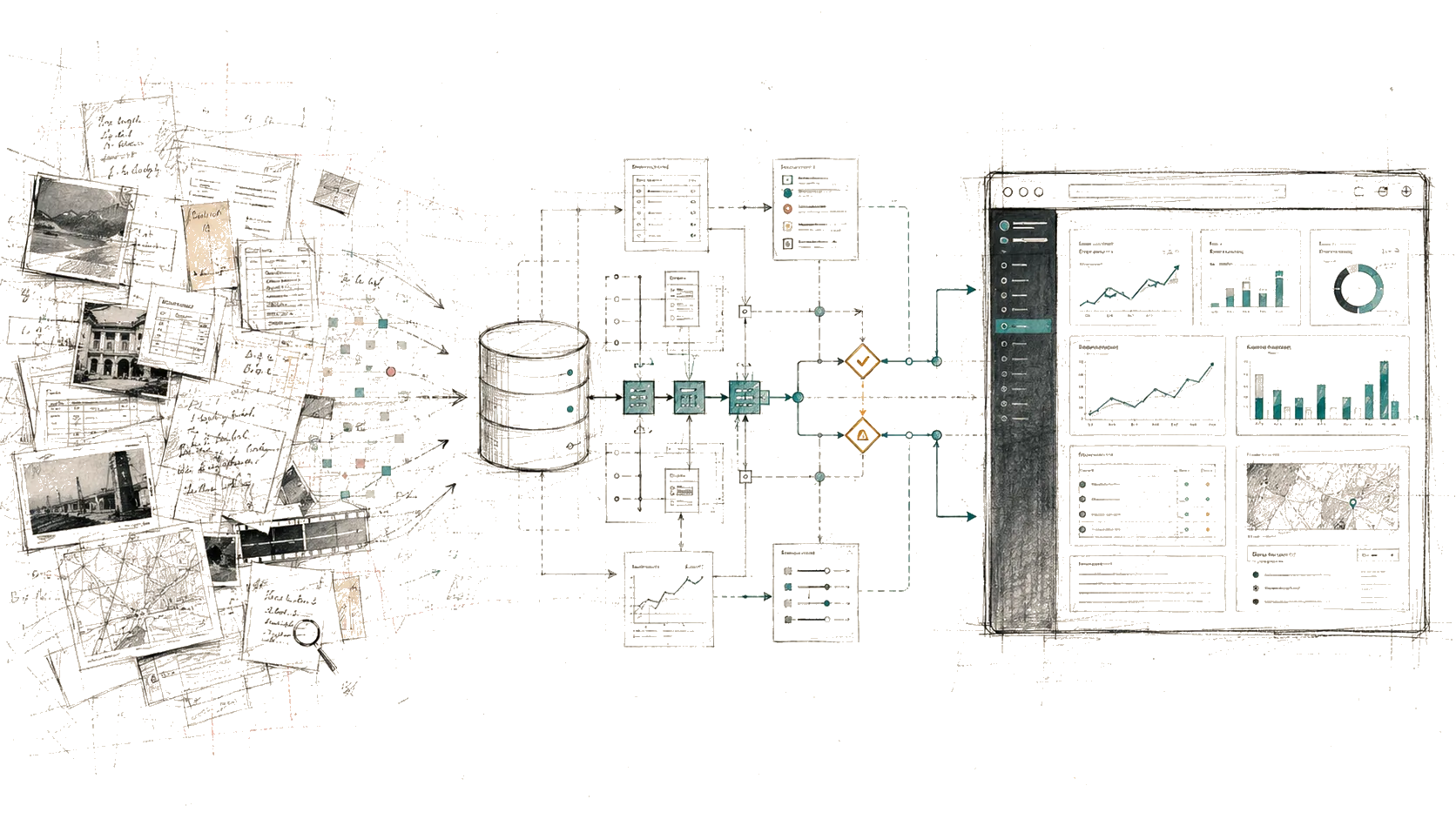
Files, records, media, source documents, databases, staff input.
Schemas, workflows, AI steps, validation, review state.
Websites, dashboards, internal tools, publishing screens.
Project handoffs
When one vendor designs the screens and another inherits the data and workflow, assumptions surface late and cost more to repair.
Files, records, media, source documents, databases, staff input.
Data models, workflows, AI pipelines, validation, review state.
Websites, dashboards, internal tools, publishing screens.
Team cost comparison
The estimator prices the senior roles commonly needed to scope, design, build, validate, and launch a custom platform.
The offering
Scope, interface decisions, technical tradeoffs, and launch criteria have a clear owner.
Every generated result keeps its sources, validation state, reviewer decision, and repair history.
Design questions are resolved against the data model and working software before they become change requests.
Systems we build
Websites connected to records, events, media, permissions, files, and staff workflows.
Structured collections with provenance, search, review state, and publication tools.
Pipelines where extraction, validation, human review, telemetry, and writeback are built into the product.
Internal tools for teams working with messy data, status changes, filters, files, and approvals.
Recent technology
Open a technology to see the job it performs in the featured work.
Application framework for routed pages, server-rendered screens, and public site delivery.
Interface layer for reusable product screens, interactive workflows, dashboards, and internal tools.
Keeps data contracts, component props, workflow state, and integration boundaries explicit across the stack.
Used for responsive layout, component styling, and fast interface iteration.
Typed database modelling for records, relationships, migrations, and domain-specific operational data.
Authentication layer for protected routes, sessions, staff tools, and authenticated product workflows.
Edge runtime for application pages, API routes, file handling, and deployment workflows.
Cloudflare-native relational storage for Workers-deployed apps and structured product data.
Object storage for media, generated assets, document artifacts, and file-backed workflows.
Payment and billing infrastructure for subscriptions, checkout, and account commerce.
Used for pipeline work, AI tooling, data repair, extraction, enrichment, and operational scripts.
Modelling and prototype ML layer for sequence analysis, evaluation, and applied AI research workflows.
Numerical foundation for compact inference paths, model artifacts, and data-heavy Python operations.
Local and embedded relational storage for development, prototypes, imports, and focused operational datasets.
Python-side validation for AI, extraction, and service workflows where structured inputs and outputs matter.
Runtime validation for form inputs, server actions, API payloads, and typed workflow boundaries.
Bridges Next.js apps into Cloudflare deployment targets while preserving the App Router model.
Test runner for focused unit and integration coverage around parsing, data transforms, and product logic.
Recent work
Public sites, staff tools, data models, workflow screens, and research prototypes from recent work.
Bring us a workflow that off-the-shelf software cannot represent.
Send a project brief