ML security systems
Behavioural baselines, anomaly scoring, peer context, model evaluation, and threshold tuning.
Security AI systems
A model score needs context, evidence, and a review path.
Vyshyvka builds the data pipelines, review screens, and reports around the model so analysts can inspect the evidence and decide what happens next.
What this covers
Operating range
Experience in sensitive environments covers behavioural analytics, LLM-assisted triage, analyst tooling, and investigation reporting. Each implementation preserves the source events, scoring context, analyst decision, and final report.
Requirements
A useful tool starts with a defined security problem and usable data. It constrains model output, provides a review path, and produces reports that analysts can challenge.
Behavioural baselines, anomaly scoring, peer context, model evaluation, and threshold tuning.
Structured triage, drift checks, evidence handling, escalation paths, and cost-aware gating.
Telemetry modelling, signal persistence, migrations, ingestion boundaries, and reviewable records.
Triage queues, case views, dashboards, evidence tables, analyst actions, and audit trails.
Authentication-aware deployment, containerized services, cloud infrastructure, search, health checks, and jobs.
Security reporting with clear methods, caveats, evidence summaries, and decision-ready findings.
Relevant experience
The work includes event schemas, scoring services, analyst queues, evidence views, audit records, and written findings with stated caveats.
Signal definitions, model-assisted scoring, analyst review states, feedback paths, and dashboard views.
Staged review logic, structured model outputs, persistence, quality gates, and human escalation.
Queue state, case escalation, evidence tables, dashboard views, and analyst actions.
Role-aware controls, audit logging, unstructured log parsing, weighted review logic, and exception handling.
Model training, statistical scoring, experimental graph work, searchable outputs, and evaluation loops.
Multi-source analysis, caveated findings, review-ready summaries, and clear methods.
Narrative Security
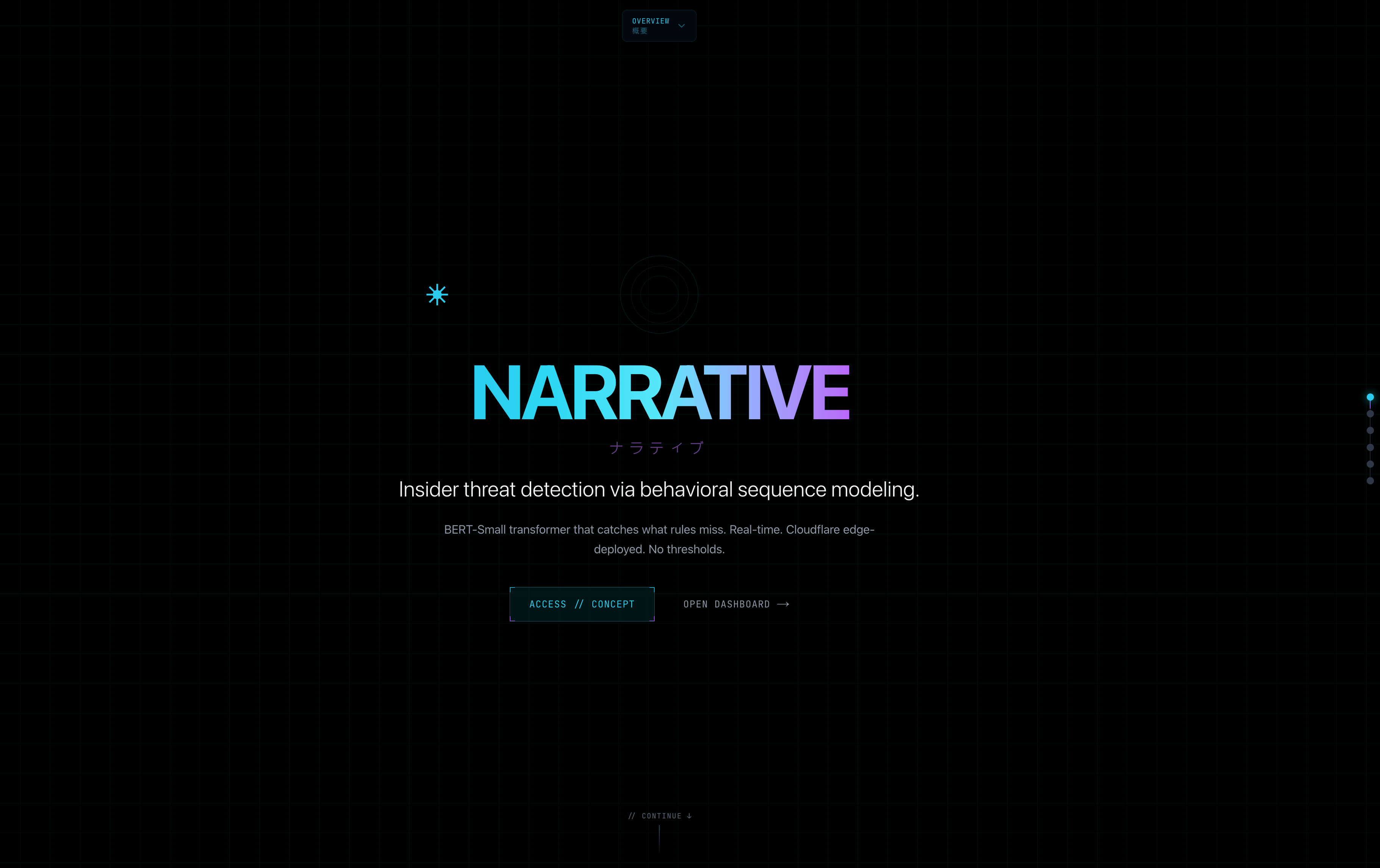
Narrative models user behaviour as event sequences, scores unusual activity with user and peer context, and presents the result in a SOC-style dashboard for review.
Security analytics platform
Prototype work covering behavioural sequence scoring, Cloudflare-based runtime architecture, SOC dashboard screens, alert review, user context, red-team review, and model explanation.
View case studyReview requirements
Before a tool can trigger an action, analysts need to see the source events, the model's inference, and the decision that still requires human review.
Signals, model outputs, and findings include source references, caveats, and the context an analyst needs for review.
Contracts keep service outputs, queue payloads, filters, and analyst actions explicit.
The delivery plan covers training, evaluation, quantization, artifact storage, and active-version switching.
Analyst tools need queues, timelines, peer context, review screens, data exploration, and audit records.
First discussion
Include the telemetry available, who reviews it, what decision follows, and which errors would be costly.
Walk through the event model, scoring path, deployment shape, UI surfaces, and tradeoffs.
Map the real security, AI, or data problem to systems that have been built and operated.
Discuss contracts, validation, artifacts, workflow boundaries, reliability, and implementation choices.
Use noisy telemetry, ambiguous behaviour, stakeholder constraints, and evidence requirements.
Project fit
Good fit
Not a fit
Start the work
Include the available telemetry, current triage process, and the action an analyst may take after review.
Send a project brief